
Everest Rules: Climbers Must Summit a 7,000m Peak First with in Nepal
Everest has never just been a mountain.
It has always been a system, political, economic, and deeply commercial.
Now, Nepal is preparing to change that system.
A new Tourism Bill passed by Nepal’s National Assembly proposes a significant shift:
Any climber who wants to attempt Everest must first summit a 7,000-meter peak in Nepal.
If approved by the lower house and signed into law, this regulation will redefine how climbers prepare for the world’s highest mountain.
And it may change Himalayan climbing more than we realize.
The Core Rule: 7,000m Requirement Before Everest
Under the proposed regulation, foreign climbers will be required to show proof of having successfully climbed at least one 7,000-meter mountain inside Nepal before receiving an Everest permit.
Specifically Nepal. Not anywhere else.
This is the first time such a rule would be embedded into national law rather than departmental guidelines.
On the surface, the reasoning is simple:
- Reduce inexperienced climbers
- Reduce congestion
- Improve safety
- Protect rescue infrastructure
But as with most Himalayan policies, there is more beneath the surface.
A Safety Measure, Or a Revenue Strategy?
Every spring, Everest sees between 800 and 900 permits issued. The mountain has become crowded, especially on summit days. Inexperienced clients relying heavily on guides and oxygen systems have contributed to traffic jams and rescue pressure.
Requiring a 7,000m climb adds:
- High-altitude exposure
- Expedition discipline
- Technical preparedness
- Financial filtering
But it also ensures something else:
The revenue stays in Nepal.
Nepal has 86 peaks between 7,000m and 7,999m. Examples include:
These mountains have already seen increased commercial interest in recent years. With this rule, demand will grow further.
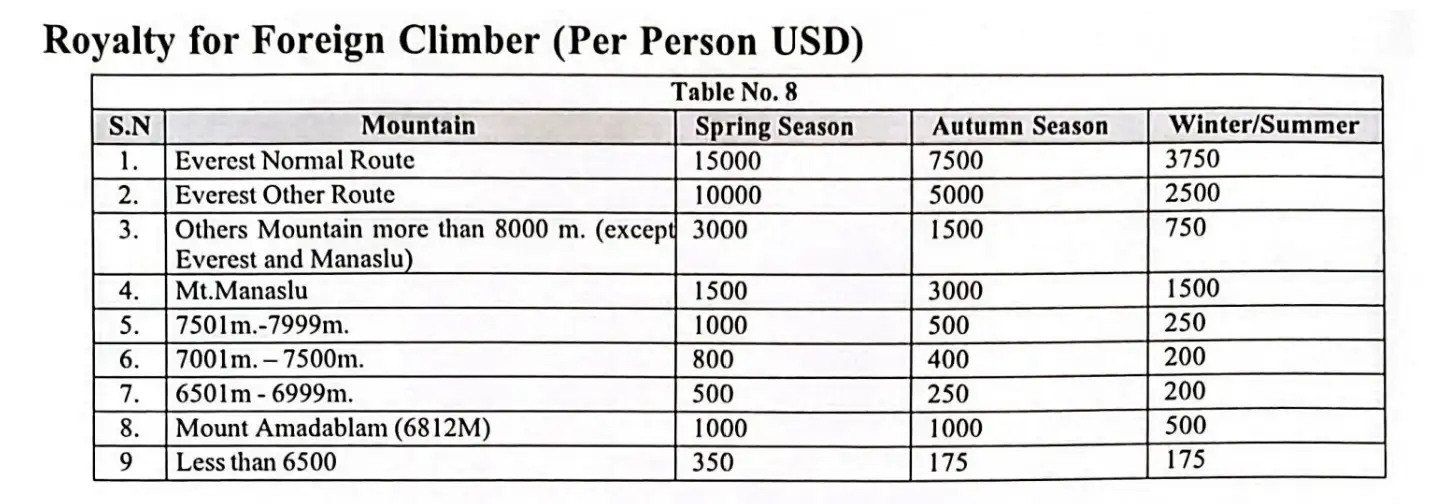
Looking at the updated royalty table from Nepal’s Department of Tourism:
- 7001m–7500m peaks cost $800 per foreign climber in spring
- 7501m–7999m peaks cost $1000 in spring
- Fees drop 50% in autumn
Everest’s spring royalty alone stands at $15,000 per person on the normal route.
So while the regulation promotes safety, it also strengthens Nepal’s expedition economy.
Both can be true.
Health Certificates and Style Declarations
The bill goes beyond experience requirements.
Climbers must now:
- Submit a recent health certificate
- Provide a detailed climbing plan
- Declare intended route and style
That includes stating whether they plan to climb with or without supplementary oxygen.
Interestingly, this may reduce the trend of climbers announcing “no oxygen” attempts only to switch strategies during summit pushes.
The regulation also extends health and insurance requirements to:
- Guides
- Sherpas
- Liaison officers
- Support staff
That is an important shift. Historically, safety focus centered primarily on clients.
Environmental Fund: A Structural Change
Nepal already requires a garbage deposit (previously $4,000 refundable upon waste return).
The new bill lays the groundwork for a centralized environmental protection fund.
Instead of scattered fees and deposits, funds will reportedly be consolidated to support:
- Waste management
- High-altitude environmental programs
- Mountain conservation
This formalization signals Nepal’s attempt to modernize mountaineering governance.
What the Bill Does NOT Address
Notably absent from the current draft:
- No cap on total Everest permits
- No explicit regulation of helicopter usage above Base Camp
- No mention of drone use (which proved useful for Icefall route fixing)
The congestion debate has largely focused on experience levels, but many argue that sheer numbers are the bigger issue.
That discussion remains open.
Will It Affect This Season?
The bill must still pass through Nepal’s House of Representatives and return for final approval before receiving presidential signature.
Realistically, it will not impact the current spring season.
In fact, there may be a temporary surge of climbers attempting Everest before the rule becomes law.
What This Means for Indian Climbers
For Indian aspirants, this changes the preparation pathway significantly.
Traditionally, many climbers progress:
6,000m → 6,500m → 8,000m
Now, a 7,000m expedition becomes mandatory.
That adds:
- Time (one additional expedition cycle)
- Cost (permit + logistics + guiding)
- Training complexity
But it may also build stronger climbers.
From experience, the jump from 6,000m to 8,000m is not linear. A 7,000m peak teaches:
- Sustained high-altitude exposure
- Multi-camp logistics
- Weather patience
- Oxygen decision-making
- Expedition fatigue management
These are lessons Everest demands.
My Perspective
From my own time in the Himalaya, I have seen how high-altitude discipline matters. I see:
Yes, Everest has seen a rise in commercially supported climbers with limited high-altitude background.
Yes, congestion has become dangerous.
But Everest has also become a global industry.
This regulation:
- Will it eliminate congestion? Probably not.
- Will it improve overall preparedness? Likely yes.
- Will it make Everest more expensive? Certainly.
The Bigger Picture
Everest is evolving.
It is no longer just a summit challenge. It is a regulated, commercial, politically managed enterprise.
Requiring a Nepal 7,000m peak is Nepal’s way of reclaiming structure in an industry that has grown rapidly.
Whether this leads to safer climbing or simply more expensive climbing will depend on how strictly the rules are enforced.
But one thing is clear:
The era of walking onto Everest with hardly any climbing résumé can be difficult.
And perhaps that is not entirely a bad thing.
Source: Reporting based on coverage from ExplorersWeb and The Kathmandu Post, along with Nepal Department of Tourism documentation.
FAQ:
Do you now need to climb a 7,000m peak before Everest?
Does the 7,000m peak have to be in Nepal?
Yes. The regulation specifically requires the 7,000m ascent to be in Nepal. Experience on peaks in other countries will not qualify under the proposed law.
When will the new Everest rule take effect?
How much does an Everest permit cost in 2026?
As per Nepal’s updated royalty table, the spring permit fee for Everest’s normal route is $15,000 per foreign climber. Additional expedition costs typically range from $35,000 to $60,000 depending on luxury, logistics and support.