The project
Bright English Medium School
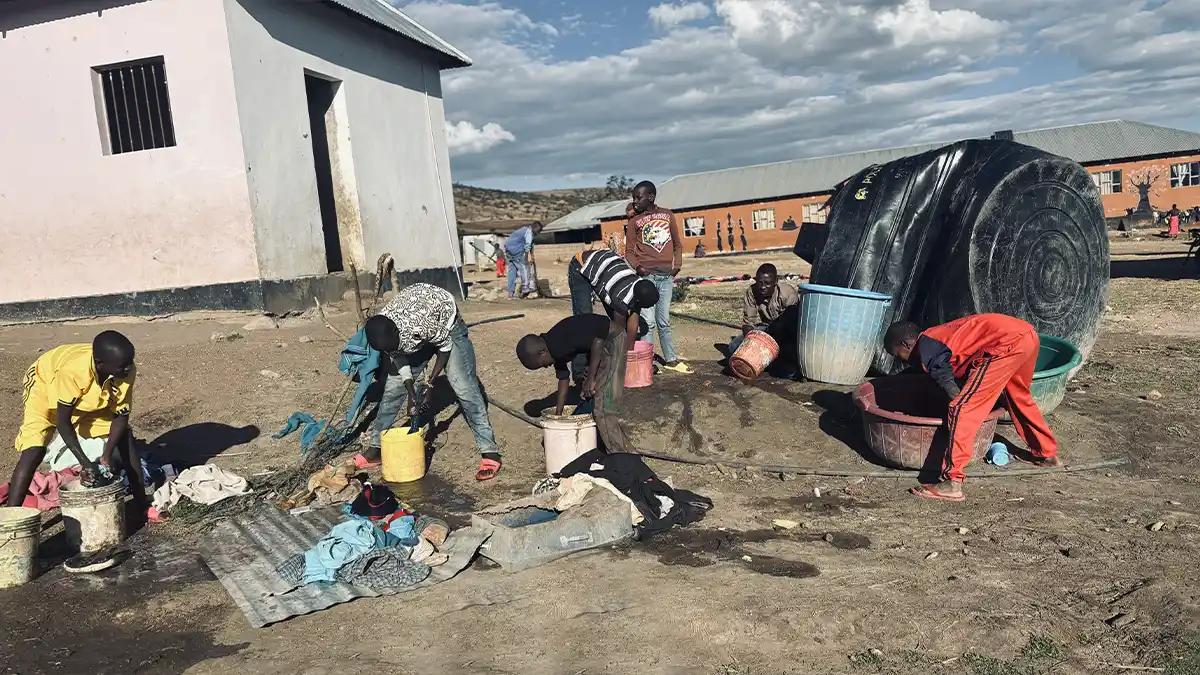
Loliondo, northern Tanzania. 530 children, about three hundred of whom board on campus — which means the school is not only where they study. It is where they wash, eat and sleep.
Founded and run by Mrs. Juliana and Mr. Baraka. Reliable water was never on the property, and everything below follows from that one fact.
Venky and Anu supervise the work on site, in person. Every phase is carried in collaboration with Project Breathe Foundation.
Ground to glass
Water at 150 metres is not water in a child’s hand.
Between the two there are seven steps. Reach it, lift it, power the lift, store it, clean it, carry it across the campus, and finally eat and drink from something that is not a washed-out paint tin.
Two are finished. Five are not. A chain does not work at five sevenths — until the last link closes, a borehole is a hole with water at the bottom of it.
Two of the open links are the plates and the plumbing. Those are being raised separately and do not wait on the tank. The other three are the water system.
Phase 1 · Complete · January 2026
The water is out of the ground.
Drilled to 150 metres, tested, sealed, and a submersible pump installed.
This was the part that could have failed outright. The area sits in an internal drainage basin, and until you drill nobody knows what is down there or how far down. It came in at 150 metres.
The books
To the 118 people who paid for it: this is closed, and we are not coming back to you. What follows is being raised elsewhere.
The film
How the Squirrel Got Lines on His Back
A short film about the drilling, and the people who did it.
In the Ramayana, an army builds a bridge across the sea while a squirrel carries single grains of sand. Rama picks the squirrel up and runs three fingers down its back.
The story is not about the size of the effort. It is about doing it with everything you have.
Plates and plumbing · In discussion
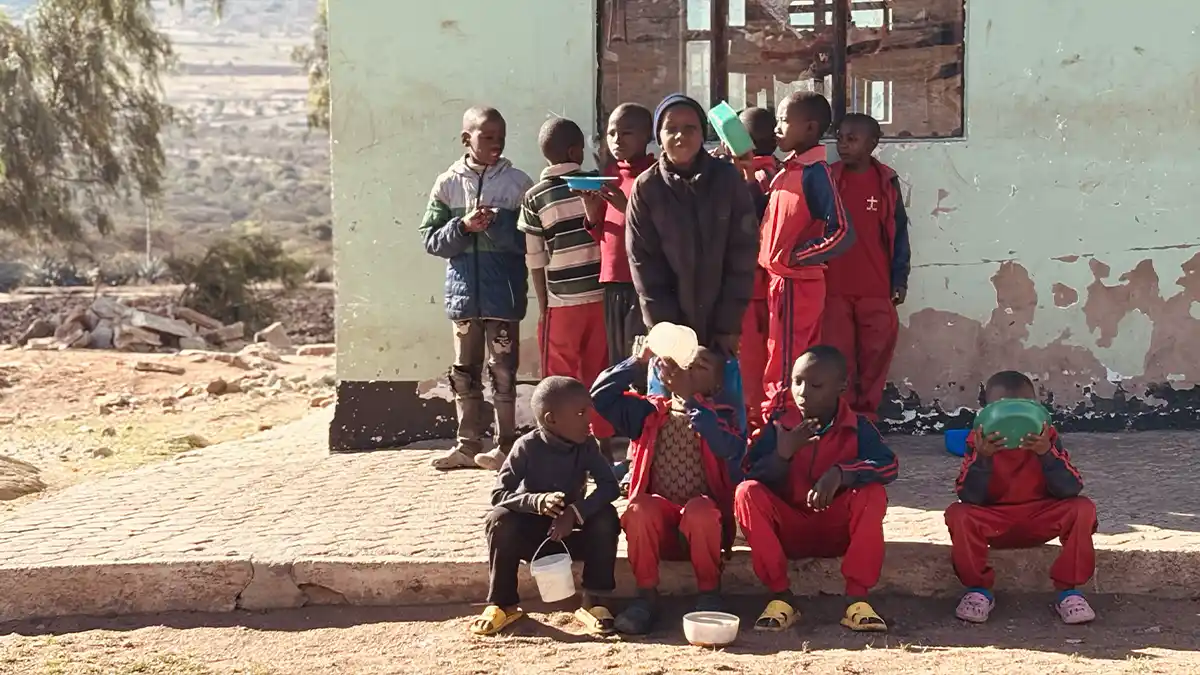
Fifteen hundred meals a day, eaten off plastic.
This is not a phase, and it does not sit behind the water system in a queue. It is being raised separately and can start whether or not the tank is ever built.
This is not a comfort upgrade. It is a health measure.
530 children, three meals a day, out of low-grade plastic bowls — some of them washed-out paint tins. Hot food, in plastic that was never made to hold food, every day of the year.
Alongside it, the plumbing in both hostels needs complete repair, and the broken window glass and doors around the school need fixing before another cold season.
Why the grade of steel decides everything
We are buying these once. We are buying them properly.
Stainless steel is sold in grades, and the difference decides whether this lasts five years or fifty. The cheap grade is 202 — low nickel, high manganese. The food-grade one is 304, with higher chromium and nickel.
Under daily washing, 202 pits, stains and rusts, and is finished within a few years. 304 does not. It will still be in service two decades from now.
The plates belong to the school. Not to the child.
A student leaving Bright English — at the end of their final year or halfway through — returns the plate and tumbler to the kitchen admin officer. If it cannot be returned, it is replaced with another. Not paid for. Replaced.
Money gets spent on something else. A plate stays a plate. Hundreds of children pass through this school over the next fifteen years, and every one of them learns that the school’s property is theirs to look after and to hand on.
750 sets for 530 children. The school grows, plates get dropped, and children join every year. Two hundred and twenty spare sets mean nobody waits on a plate for the next decade, and the school never has to find the money for a replacement batch.
Phase 2 · Open
Finish the chain, and hand over a system that runs itself.
The pump works when the grid works, and the grid in Loliondo fails constantly. There is no storage, so nothing is held for the hours the power is down. There is no filtration, so what reaches the surface is not yet safe to drink.
Three pieces close it. Solar to run the pump through daylight hours. An elevated tank to hold six thousand litres. Filtration at the point of use.
The tanks the school has now lie on their sides on bare ground. No height means no pressure, no pressure means buckets, and anything on the ground gets into the water.
The tank
What it costs
The contingency is stated rather than hidden inside the line items. On a remote site, twelve percent is the difference between finishing and going back to ask for more.
After it is built
A ten-year maintenance schedule goes to the school with the handover.
The school runs this. Nobody has to fly from India to drain a tank.
What ten lakh does
Ten lakh initiates the tank construction. A further five completes the solar installation and the filtration.
If it comes from one person, it starts sooner. If it comes from twelve, it is the same tank.

How this is paid for
Everything the book earns goes to this school.
Every rupee of royalty UNFAILING earns goes to Bright English Medium School, whether or not a single person donates.
A plan that depends on somebody else saying yes is not a plan. Donations come and they go, and some years they do not come at all. The book is the floor underneath this work, and it is the one part of it we control.
What the book pays for
Every number here is worked on the lowest royalty Amazon pays, as if every copy were sold in India. Every copy sold outside India carries more. Book money and donated money pay for the same list, and whichever arrives first pays for the next open piece.
Three copies buy one child a steel plate and tumbler she will still be eating off in 2046. Eight, if you are buying in India. Not a donation. A book you keep, and equipment that outlives the decision to buy it.
Giving directly is open too, and it makes the work go faster. It is not what the work rests on.
Amazon keeps its share first. What reaches us is about ₹55 of every ₹99 in India, and about $1.94 of every $2.99 elsewhere. All of that goes to the school.
Accountability
Where the money goes, and how you will know.
The same four promises hold here as on every project, from the first rupee to the closing account.
Every contribution goes to the work described, and to nothing else.
At the close of each phase we publish the account, with photographs, and records available on request.
Surplus goes to the remaining work in strict order of priority. Nothing is diverted and nothing is spent twice.
When a phase is closed, we do not go back to the people who funded it.
Venkata S Bhojanapalli · storieswithvenky@gmail.com
Anurag Nallavelli · anuragnallavelli@gmail.com · projectbreathefoundation.org
In collaboration with Project Breathe Foundation
Children first is not a campaign. It is the direction.